| |
|
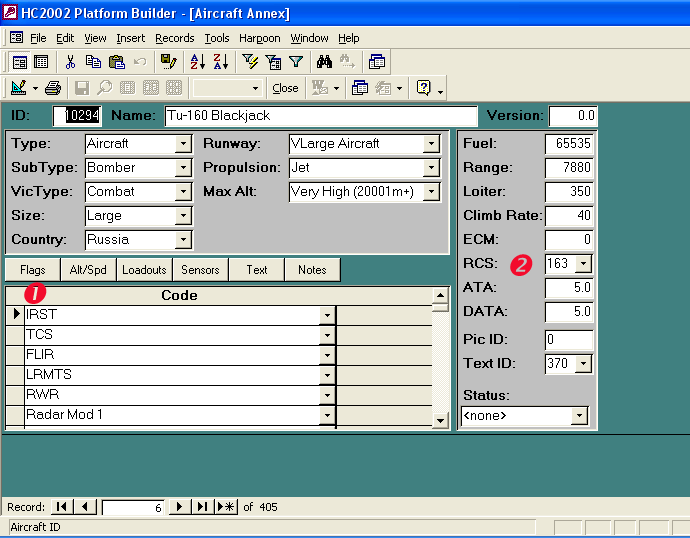
This section will examine the Aircraft Flags (1) and Radar Cross
Section or "RCS" (2). The other data entry fields should
be self-explanatory, but if you need help, please use the "Contact
Us" button, or post your questions to the Database section
for Harpoon Classic Gold at the HarpGamer Forums.
Data
fields that require value inputs derive from best sources of information,
often, but not exclusively, Harpoon Paper Rules. (ECM
is currently modeled through the Game Engine. Increasing the ECM
value will decrease the aircraft's likelihood of being hit by
missiles, which would compromise the GE's current hit percentage
algorithm, so we recommend you leave that value as zero for now.)
In making new entries or editing existing
ones, the guiding principle should be to look for how similar
platforms are entered and make adjustments as you deem necessary
for your platform's own unique characteristics.
|
|
|
| |
|
AIRCRAFT FLAGS (1)
|
|
|
| |
|
Each
of these Flags has the potential to affect aircraft behavior in
the Game Engine (GE), depending on how they are treated in the
source code. "Has the potential", because not all the
Flags listed are actually employed by the source code as of this
writing.
When
building or upgrading aircraft in your database, you will want
to associate as many of the Flags from the table below as are
applicable to reflect the aircraft's characteristics and capabilities.
| |
#
|
FLAG |
DESCRIPTION |
|
| |
0
|
IRST |
Infra-Red
Search and Tracking: A passive Air-to-Air detection method
using the target's heat signature to find it and track it.
|
|
| |
1
|
MAD |
Magnetic Anomaly Detection: Used to locate Submarines from
the air by finding the disruption in the Earth's Magnetic
Field, caused by the boat's metal hull.
|
|
| |
2
|
TCS |
Television Camera System: another passive Air-to-Air detection
system using a specialized TV Camera to locate and track
other aircraft.
|
|
| |
3
|
FLIR |
Forward Looking Infra-Red: A Passive Air-to-Ground detection
system based upon target's heat signature.
|
|
| |
4
|
LRMTS |
Laser Ranger and Marked Target Seeker: Normally used in
marking targets for bombing missions, this Flag is used
by Harpoon Classic to indicate a plane's ability to safely
fly Nap of the Earth ( or VLOW altitude, as Harpoon Classic
models it).
|
|
| |
5
|
Blip
enhance |
An electronic subterfuge that magnifies a small aircraft's
radar signature, typically that of a helicopter, to make
it appear much larger on enemy radar screens and to decoy
radar homing missiles.
|
|
| |
6
|
ESM |
Electronic Surveillance Measures: Systems that detect electronic
emissions of platforms and weapons, providing a vector to
the emitter, analyzing it against a known database and thereby
enabling identification.
|
|
| |
7
|
RWR |
Radar Warning Receiver: Alerts the pilot that his aircraft
is under attack from a radar homing missile.
|
|
| |
8
|
DPS |
Digital Processing System(?): We are unsure of this one's
purpose, as it does not appear to be implemented within
the source code and thus has no current function in game
play.
|
|
| |
9
|
SB |
Sonobuoy: Signifies an existing comm link for data transfer
from sonobuoy to aircraft. While not currently implemented
in the GE source code as such (Sonobuoys nevertheless do
function properly via a different code mechanism), all platforms
with SB comm links in real life should be given this flag
for reference purposes and in case this flag is implemented
in the GE at some future date.
|
|
| |
10
|
Radar
Mod 1 |
Radar Mod Flags 1 and 2: These flags are no longer implemented
as of HC2005. However, in all earlier versions they were
very important in modeling relative stealth of aircraft.
Under the old system no radar mod flag was stealthiest,
less stealthy was Radar Mod 1, even less so was Radar Mod
2, and any aircraft with Radar Mods 1 and 2 had the least
stealth with respect to detection by radar. |
|
| |
11
|
Radar
Mod 2 |
|
| |
12
|
Inflight
refuelling |
This flag means that an aircraft is capable of receiving
in-flight refueling from a tanker aircraft.
|
|
| |
13
|
All-weather
capable |
This flag would indicate all weather capability for an aircraft,
but is not currently modeled in the GE. Nevertheless, for
the same reasons as above in the SB flag, it is recommended
to include this flag where appropriate.
|
|
| |
14
|
Mid-course
guidance |
Missiles with the mid-course guidance flag are capable of
receiving course correction and new targeting information
in mid-flight, thereby improving their Hit Percentage (PH)
over missiles lacking this feature. While the GE currently
treats all aircraft as if they have this flag, it may, in
the future, come to model the comm link that is needed from
aircraft to missile, so we recommend adding it where appropriate
as well. Right now, only the missile that is mid-course
guidance capable (not the aircraft itself) actually requires
the flag to be present.
|
|
| |
15
|
Carrier
capable |
Carrier capable aircraft are just that -- capable of flight
operations to and from an aircraft carrier. This flag is
also needed to enable helos and VTOL aircraft to operate
from ships.
|
|
| |
RADAR CROSS SECTION (2)
|
| |
Radar Cross Section replaces the Radar Mod Flag method
of modeling stealth for planes, and also applies to ships
and surfaced submarines in Harpoon Classic 2005's revised
detection model. The examples below represent a sampling
of radar cross section values for commonly used aircraft
in the GE. The values posted come from a recent version
of the HCDB. Your values, and future values of the HCDB
may differ from those seen here.
|
| |
RCS
_#_
|
Aircraft Model
|
Notes
|
|
| |
73
|
B-2A
Spirit
|
Note
the spread between the B-2A, the F/A-22, and the F-117A.
All of these stealthy aircraft fall within a 22 unit spread
on the HC-RCS scale. That's a lot of room when compared
to the E-3F Sentry AWACS (at 163) and the C-160R
Transall
(at 164). Why? The reason has to do with the limitations
of detection instrumentation.
Simply
put, if an aircraft (or other platform or weapon) is very
stealthy, the distance at which it will be detected is orders
of magnitude greater with each improvement in stealth technology.
But if it's not stealthy, it does not matter much whether
you are trying to find the C-160R or a flying version of
the QEII luxury liner. Both of theses are going to be detected
at the maximum rated instrument range for the detecting
electronics system. |
|
| |
85
|
F/A-22
Raptor |
|
| |
95 |
F117-A
Nighthawk
|
|
| |
104
|
Rafale
B |
The
remaining listings are included for comparative analysis,
in order to give you a feel for how the HC-RCS system applies
to aircraft commonly used in Harpoon Classic.
Also, when making a new platform or when remodeling the
stealth characteristics of an existing one, making reference
to the various listings in the PE's RCS dropdown will assist
you in determining which value to assign.
It
should also be noted that the HC-RCS model works in conjunction
with weather, chance (via a computer-simulated die roll),
and is limited not only by instrumentation characteristics,
but also by Radar Line of Sight.
For
a copy of the MS Excel spreadsheet that Tony Eischens produced
when creating the HC-RCS model, please use the following
link:
HC-RCS
MS Excel Spreadsheet |
|
| |
110
|
F/A-18E
Super Hornet |
|
| |
120
|
Eurofighter
Typhoon
|
|
| |
128
|
F-16C/D
Block 50/52 |
|
| |
133
|
F-16A
Falcon |
|
| |
135 |
UH-60
Blackhawk
|
|
| |
145
|
Tornado
F.3/ADV |
|
| |
156
|
Su-35
Flanker |
|
| |
163
|
E-3F
Sentry AWACS
|
|
| |
164
|
C-160R
Transall |
|
| |
|
|
|
PE
User's Guide
Aircraft Appendix, rev. 050315.1
Written
by Bruce Fenster, with special thanks to Brad Leyte and Anthony
Eischens for their support and technical assistance.
Copyright
© 2005 HarpGamer.com
PE User's Guide
Aircraft Appendix
|
|
|
Harpoon™
is owned by Larry Bond and Chris Carlson, and licensed to AGSI, for
the purpose of developing the computer versions. This
site is not affiliated with either entity.
|